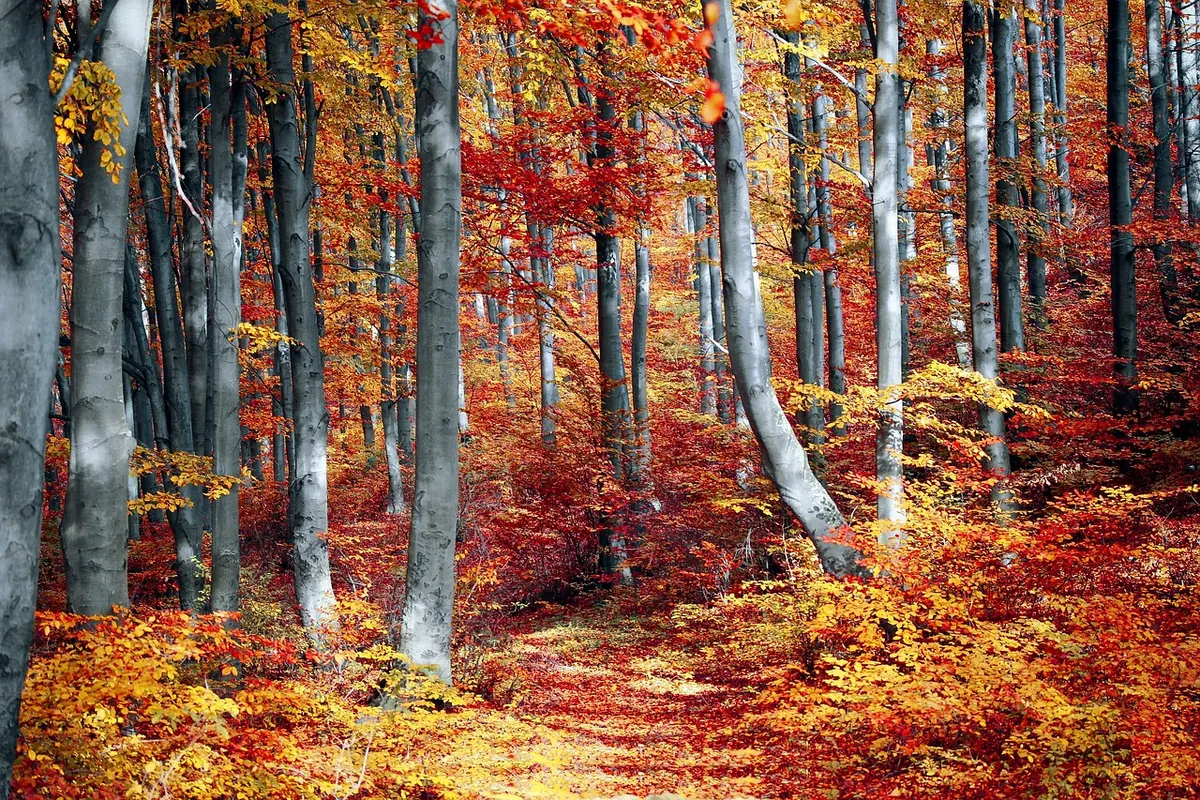
Photographing Autumn Leaf Litter: 7 Composition Ideas

Autumn gets photographed from the top down. People chase the canopy, the ridge line, the reflection in the lake, then walk back to the car with their eyes still lifted. Meanwhile the floor of the wood is doing something more interesting: oak and beech layered over wet soil, colour shifting from rust to ochre to a bruised purple, a mushroom pushing through, one yellow leaf half sunk in a puddle. Leaf litter is close, quiet and almost always overlooked — which is exactly why it can produce pictures that don't look like everyone else's October. The seven approaches below are less about gear than about where you put your knees and what you decide to leave out of the frame.
Standing over a drift of leaves flattens it into a carpet. Kneel down and the same patch becomes a landscape: ridges, valleys, a curl of birch bark that suddenly reads like a boulder. The single most useful change you can make is to bring the lens down to twenty or thirty centimetres above the ground and point it roughly parallel to the litter rather than straight down at it.
That angle does two things. It gives you a foreground — three or four leaves rendered soft at the bottom of the frame — and it turns the rest of the floor into a receding field of texture instead of a flat pattern. A standard lens at f/2.8 from close range is often enough; you don't need a macro. If you're shooting on a phone, put the lens within a hand's width of the nearest leaf and tilt the screen so you aren't guessing.
Practicalities matter here. Take a foam kneeling pad or a folded bin liner, because wet leaf mould soaks through trousers in seconds. Check the ground with your hand before you commit your weight — wasps, broken glass and dog mess all live in the same places as good light. And wipe your front element afterwards; a single fingerprint on a low-contrast subject kills the frame.
Litter photographs fail most often through greed. Everything in the frame is interesting, so nothing is. The fix is to choose one leaf and give it room.
Place a single red maple leaf in the lower third of the frame and let the rest of the picture be soft brown floor. The eye needs somewhere to rest, and empty litter — out of focus, undemanding — does that job well. Resist the urge to crop in tight. Try a version with the leaf small in the frame and see how much more weight it carries.
Look for a leaf that sits against a background that isn't another leaf of the same colour: a scarlet leaf on green moss, a pale beech leaf on dark wet soil, a skeletal skeletonised leaf against a rust-coloured drift. Colour contrast is the easiest story to tell on a forest floor, and it doesn't need any explaining.
Some of the strongest autumn pictures are almost abstract. Fill the entire frame with leaves — no sky, no horizon, no path — until the image becomes a field of repeating shapes and shifting colour. Check the corners before you fire. A stray twig or a sliver of pale sky at the edge will pull the eye straight out of the picture.
Then break the pattern deliberately. A single green leaf among the copper ones. A white feather. A mushroom cap. One interruption gives the eye an entry point and turns decoration into a photograph. Place it off-centre, roughly a third of the way in, and make sure it's the sharpest thing in the frame. This is the composition that rewards patience most: you'll walk past fifty unbroken drifts before you find one with a natural focal point sitting in it.
Texture alone can be beautiful, but depth is what makes a viewer feel they could step into the picture. You get it by layering: something soft and near, something sharp in the middle, something soft and far away.
Backlight helps enormously. With the sun low and behind the subject, translucent leaves glow and separate from the darker floor behind them. Shade the front of the lens with your hand to stop flare washing out the contrast. And remember that depth of field collapses at close range: at thirty centimetres, f/8 may cover only a couple of centimetres. Either stop down and use a low tripod, or take three to six frames at slightly different focus distances and blend them later.
A leading line finishes the job. A bare root, an exposed strip of soil, the curve of a footpath or an old branch lying across the litter will carry the eye from the front of the frame to the back.
A picture of leaves is a picture of leaves. Add a mossy stump, a drystone wall, a rusted gate, a fallen fence post or a pair of walking boots and it becomes a picture of a place in a season. These anchors also give scale: without one, the viewer has no idea whether they're looking at a metre of woodland or the contents of a window box.
Choose anchors with a different texture from the litter — hard and grey against soft and orange, wet and dark against dry and pale. Keep them simple and slightly off-centre, and let the leaves run past them into the background. Avoid anything with lettering or bright plastic in it; the eye goes to text before it goes to colour, every time.
Litter isn't static. Wind moves it in little waves, leaves tumble down through the frame, rain drums on it, puddles collect in the hollows. A shutter speed of around 1/500 freezes a falling leaf mid-air; drop to 1/30 or slower and it becomes a soft streak of colour, which is often the more evocative result. Brace the camera on a bag or a tripod and take several attempts.
Weather does more for forest-floor colour than any editing decision. Wet leaves are saturated and reflective; overcast light removes the harsh highlights that blow out pale beech and birch, so the whole floor reads evenly. A polarising filter will cut the sheen on wet leaves and deepen the colours, but it also removes the reflections in puddles — decide which you want before you screw it on. After rain, in flat grey light, with mist softening the background, you have the best conditions the season offers. Go out in them.
A few habits make these sessions more productive and more comfortable:
Shoot for an hour in soft light, keep your horizons level, and review your frames on the back of the camera while you're still kneeling — you'll spot the stray twig and the empty corner far more easily in the field than at home. The forest floor rewards slow looking more than expensive equipment. Give it twenty minutes of your attention and it will give you pictures nobody else came home with.
Previous Post
A 3-Hour Woodland Walk Photography Checklist for Early Spring
Next Post
How to Photograph Deer in Woodland Without Disturbing Them